Like any high school in the early 1960s, Teaneck High School in New Jersey was a lively place. Perched on a gentle rise in the township, it looked like a Tudor palace in stone and brick and was known as ‘the Castle on the Hill,’ as we called it. Opened in 1928 and expanded in 1936, the building by the early 1960s was crowded with 2,300 students spread across three grades: 10th,11th and 12th. Though its architecture gave it a majestic, unique presence, inside it was lively, familiar, and full of the ordinary bustle of high-school life.

At any moment you could hear the clatter of students hurrying from one class to the next, rows of metal locker doors on both sides of the hallways banging open and shut, and kids calling out to friends across the hallway.
“What are you doing after school today?”
“See you at lunch!”
Thousands of shoes rushing to beat the bells for the next class while making plans in those hallways, smoothed down the floor tiles year after year. Plans were made to meet at the library, go to clubs, attend sports practices or games, or grab a soda or milkshake at one of the candy stores in town.
If I wasn’t going for a soda, my favorite after-school ritual was heading to my friend Sharon Maloney’s house to watch American Bandstand. Sharon lived closest to the high school amongst our friends, so her house was a good stopping point. Sometimes there was a group of 3 or 4 other friends there with us. We’d try to imitate whatever dances were popular that week. Some of the popular dances were called The Bristol Stomp, The Mashed Potatoes, The Monkey, The Twist, and The Stroll. Sometimes I would stop home first and bring my younger siblings along. No one minded 3 extra kids — it just meant more time together. My friends and I never discussed politics. It just never came up. The voting age in 1964 was still 21. We had other things to worry about within our own families.

https://www.thevideobeat.com/rock-roll-tv/ab-64.html
On Friday, November 22, 1963, I was sitting in my senior-year chemistry class, trying hard to stay focused even though my mind kept drifting to weekend plans. My then boyfriend, Stan, ( whom I would marry four years later in at the end of the summer of 1967) had gotten us tickets to see Ray Charles at Montclair State College, where he was a sophomore, and I could hardly wait. When Stan got us tickets to see Ray Charles, we knew it was going to be special. His songs were all over the radio. We watched him perform on TV and loved how he played the piano and how the Raelettes backed him. We were hoping to hear some of his well-known songs like “Georgia On My Mind”, “Busted” “Unchain My Heart” and more.
I was jolted back to the present when someone poked me to pass a note across the room. Someone else kept watch for Mr. Gilbert’s head turning. This was how we communicated in the days long before cell phones: if you wanted to make plans or complain about being bored, you passed notes and hoped you didn’t get caught.
Then, suddenly, the PA system crackled on.
That was strange. Announcements were always saved for the end of the day. We all froze.
Then we heard the voice of Miss Hill, our principal, calm but trembling, telling us that our President, John F. Kennedy, had been shot. At 43 years old, he was the youngest president ever elected and had only been in office less than 1000 days. Even though I was not particularly interested in politics, I loved seeing the Kennedys and following their story. This was a shock.
A collective breath escaped the room. We sat up straight, shocked, waiting for her next words. Miss Hill went on to tell us that school was being dismissed early, and we were to go home immediately.
No one moved at first.
And then — no one spoke.
Not a single person in the entire school.
We walked out silently, collected our things silently, and left the building silently. The halls that were always full of noise and chatter were suddenly still. It felt as if the entire school — maybe the entire country — had stopped breathing.
Later that afternoon, Stan came over. We walked around the block together, barely saying a word. The Ray Charles concert for the next day was cancelled. We weren’t even disappointed. We were too numb from the current events. Everyone stayed glued to their televisions, trying to make sense of what had happened.
The following week, midterms were scheduled to begin. My first exam, German, was set for Monday, and I felt torn. I wanted to keep watching the news, but I knew I had to study. I tried to do both — reviewing vocabulary while turning the TV back on every so often to see what was unfolding.
Then came another shock: as I was studying, I heard that Jack Ruby had shot Lee Harvey Oswald, the man accused of killing President Kennedy — and it had happened on live television. I missed it.
That evening, I learned that school would be closed on Monday so that everyone could stay home and watch the funeral. I remember thinking, “I could have saved my studying for Monday night. Who knew the world would turn upside down again?” The Kennedys were the closest thing we had to royalty in the United States. Jacqueline Kennedy, wife of the president, always beautifully dressed, soft-spoken, and elegant, captured the country’s heart. Watching her and her young children during the days following the assignation was heartbreaking. It

It was hard to imagine the country without President Kennedy, and even harder to understand that these little children, Carolyn, age five, and John F. Kennedy, Jr, age two, had lost their father.
Those days felt surreal, as if time had slowed down and the whole country was holding its breath. Even now, all these years later, I can still remember the silence in the hallways, the flickering black-and-white images on the television, and the heavy feeling in the air. What I didn’t fully understand at seventeen, but I do now, is that every family, every school, every town in America was living through those same moments right alongside us.
While I was walking home in stunned silence with my classmates, history was unfolding minute by minute across the nation. Looking back, it helps to see the actual sequence of events to understand just how quickly everything happened, and how the tragedy that shook my high school classroom was part of a larger story that every household in America was watching together.
Here is a timeline of what was happening in the country during those same days — from the moment President Kennedy was shot, to the events surrounding Lee Harvey Oswald and Jack Ruby, and finally to the day the nation gathered to watch the funeral.
(Times are Central Standard Time, since Dallas is CST.)


Looking back now, I realize that the world I lived in as a teenager changed in the span of a single weekend. One moment we were passing notes in chemistry class and practicing the latest dances at Sharon’s house, and the next we were watching history happen in real time, trying to make sense of a tragedy far bigger than any of us had ever imagined.
What stayed with me most wasn’t just the news itself, but how people responded — with quiet, with respect, with a sense that we were all part of something larger than ourselves. Families gathered around their televisions, and high school students who usually had plenty to say walked the hallways in complete silence. In that silence, we felt connected — not only to each other but to millions of people across the country who were feeling the very same shock and sadness.
I share this story with you because it reminds me how moments in history are not just events written in textbooks. They are lived by ordinary people — by parents and grandparents who once sat where my grandchildren sit now. They shape us, teach us, and stay with us long after the headlines fade.
Someday my grandchildren will have their own stories of where you were when the world suddenly changed. I hope you will remember to notice not only what happened, but how people came together in those moments. That, more than anything, is what I carry with me from that November weekend in 1963.
Postscript (PS)
By the way, we did finally get to see Ray Charles… and it was worth the wait. The concert was rescheduled a few weeks later, and we got to hear him sing some of his most famous songs. His style blended blues, gospel, jazz, country, and big-band pop, and we knew every song by heart. It felt like a little light returning after a very dark time. We had seats in the bleachers of the Montclair State gymnasium, and we swayed along with his music.

Can you imagine one of today’s biggest stars performing in a college gym?
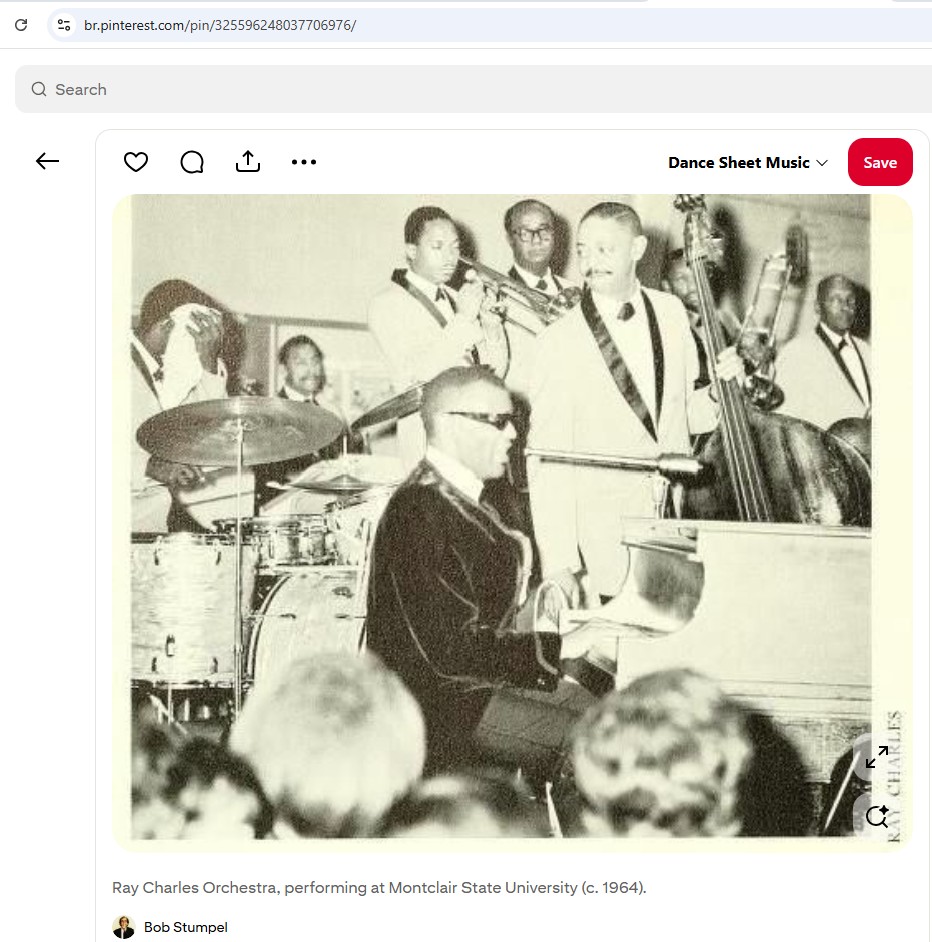
Ray Charles Playlist (1960–1964)
Click on the links to listen to some of his most popular songs and to hear some of the music we enjoyed in the early 1960s.
1. “Busted” (1963)
Hit single in 1963 — a catchy, soulful tune that kids your age would’ve known well.
🔗 https://www.youtube.com/watch?v=5AsG9tGxETg
2. “Take These Chains From My Heart” (1963)
A country song reimagined by Ray Charles — showing his incredible crossover style.
🔗 https://www.youtube.com/watch?v=ey9V1ao5v0k
3. “I Can’t Stop Loving You” (1962)
One of his biggest songs ever — #1 on the pop charts. You would have heard this everywhere.
🔗 https://www.youtube.com/watch?v=S1dSKu0CqJQ
4. “You Are My Sunshine” (1962)
Another country classic turned Ray Charles masterpiece — big with both teens and adults.
🔗 https://www.youtube.com/watch?v=q9G6I0tiVhs
5. “Hit the Road Jack” (1961)
A fun, rhythmic call-and-response song with the Raelettes — kids loved it.
🔗 https://www.youtube.com/watch?v=Q8Tiz6INF7I
6. “Georgia On My Mind” (1960)
One of his signature songs — soulful, beautiful, unforgettable.
🔗 https://www.youtube.com/watch?v=glDtJ79q7Oc
7. “Unchain My Heart” (1961)
Upbeat, energetic, and very popular. A classic Ray Charles groove.
🔗 https://www.youtube.com/watch?v=0vTpnayCmRo
8. “What’d I Say (Parts I & II)” (1959, but still HUGE in 1963)
This song made Ray Charles a superstar — and teens in 1963 definitely knew it.
🔗 https://www.youtube.com/watch?v=6OFwLiWLDh0
9. “Don’t Set Me Free” (1962)
A smooth, catchy hit still being played on the radio in 1963.
🔗 https://www.youtube.com/watch?v=cwqpuRjhDig